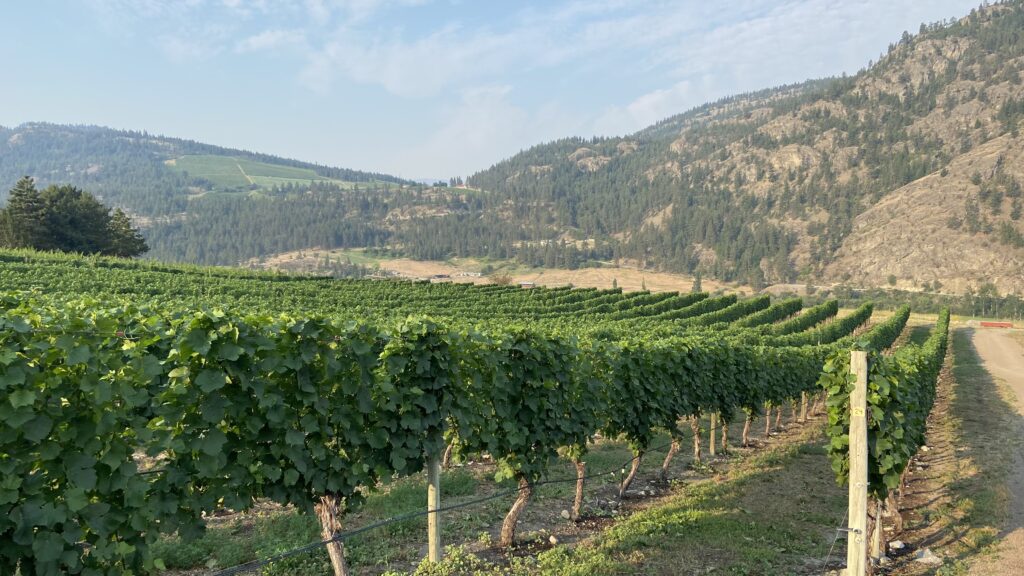
Heidi’s Peak Estate Vineyard Limited
7.5 acres2140 Sun Valley Way, Okanagan Falls, BC, V0H1R2Heidi C Lorch
Regenerative agriculture means looking after the soil (no tillage, compost application, cover crops), encouraging biodiversity (habitat steward and pollinator partner) and minimal reduced irrigation to conserve water.
Products
- Wine grapes
Regenerative Practices
- Minimize soil disturbance
- No-till (direct seeding, zero-tillage) The soil is not worked at any point throughout the season. residue from the previous crop is left on the soil surface, and its root system is left intact. the following crop is seeded directly into the soil without tillage.
- No-till (direct seeding, zero-tillage)
- Keep the soil covered and maintain living roots year-round
- Cover crops Plants grown alongside, preceding, or following cash crops with the purpose of increasing soil fertility, reducing soil erosion, and suppressing weeds.
- Organic mulch Organic mulch involves covering the soil surface with a protective barrier to increase soil health, reduce soil erosion, and suppress weeds. the mulch can be composed of various organic materials such as straw, leaves, or compost.
- Cover crops
- Protect and enhance biodiversity
- Pollinator buffers Patches or rows of diverse flowering vegetation that provide pollinators with permanent habitats and food sources. they can be planted as intercrops or at the edge of fields.
- Habitat conservation/creation/restoration The conservation, creation, and restoration of ecosystems to improve habitat value for wildlife. forests, prairies, riparian areas, or wetlands can be restored along farmland.
- Pollinator buffers
- Preserve and restore natural ecosystems
- Maintain living roots year-round (agroforestry and perennials)
- Native perennial vegetation conservation The conservation of existing—or reintroduction of—native perennial vegetation, those that occur naturally in a region in which it evolved. it includes grasslands, woodlands, wetlands, and coastal habitats.
- Native perennial vegetation conservation
- Optimize input use
- Compost Organic matter that has been recycled through a composting process into a form that can be used as a soil amendment.\r\ncompost is the stable, nutrient-rich product of decomposed organic matter—such as plant residues, manure, or food scraps—that has been biologically processed under controlled aerobic conditions.
- Biostimulants Any substance or microorganism applied to plants or soil to stimulate the plant’s ability to assimilate applied nutrients or provide benefits to plant development. biostimulants include amino acids, chitosan (biopolymers), seaweed extracts, and humic substances.
- Compost
- Improve water cycles
- Water conservation The optimized use of water for crops and trees, or strict water use during critical periods of crop stages.
- Water conservation
Observations
- With the application of compost to the vineyard, the organic matter has increased by 0.5% and reduced the pH level from 8.2 to 7.5, therefore increasing nutrient uptake by the vines.
- I have mounted bluebird nest boxes to attract Western bluebird populations to the vineyard.
How to buy
- I sell to a local winery where my wine grapes are offered to the public.