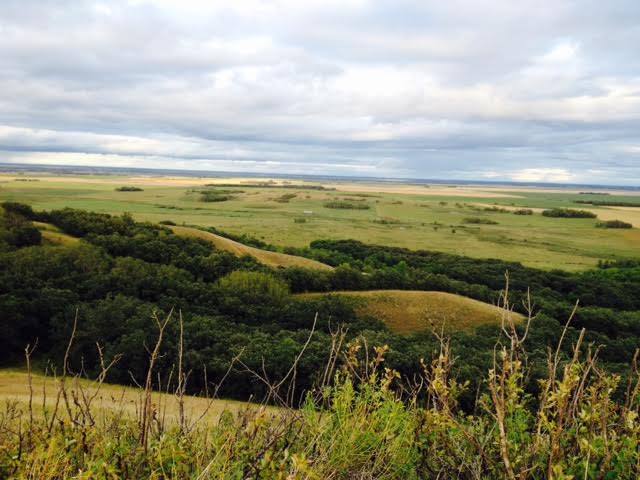
Howpark Farms
2000 acresR.R. #4 Box 25, Brandon, Manitoba, R7A 5Y4Ian, Linda & Zach Grossart
Regenerative agriculture involves increasing soil and ecosystem health to provide nutrient-dense food.
Products
- Grass-fed Organic Beef
- Pasture Pork
- Pasture Chickens
- Organic Flax
- Organic Wheat
- Organic Barley
Regenerative Practices
- Minimize soil disturbance
- Permanent grassland A parcel of land composed primarily of herbaceous grasses, including perennials and native plant species, which can be used for grazing, forage, or biomass production.
- Permanent grassland
- Keep the soil covered and maintain living roots year-round
- Cover crops Plants grown alongside, preceding, or following cash crops with the purpose of increasing soil fertility, reducing soil erosion, and suppressing weeds.
- Intercropping Simultaneously growing two or more crops adjacent to one another, on the same piece of land and within the same growing season. crops are paired based on their differing, yet complementary, space and resource requirements.
- Cover crops
- Protect and enhance biodiversity
- Diverse crop rotations Planting crops with different characteristics in sequence on the same field over time
- Pollinator buffers Patches or rows of diverse flowering vegetation that provide pollinators with permanent habitats and food sources. they can be planted as intercrops or at the edge of fields.
- Habitat conservation/creation/restoration The conservation, creation, and restoration of ecosystems to improve habitat value for wildlife. forests, prairies, riparian areas, or wetlands can be restored along farmland.
- Diverse crop rotations
- Optimize input use
- Compost Organic matter that has been recycled through a composting process into a form that can be used as a soil amendment.\r\ncompost is the stable, nutrient-rich product of decomposed organic matter—such as plant residues, manure, or food scraps—that has been biologically processed under controlled aerobic conditions.
- Compost tea A water-based compost that undergoes a fermentation process (with or without oxygen).
- Minimal to no use of synthetic pesticides Any product, device, organism, substance or thing that is manufactured, represented, sold or used as a means for directly or indirectly controlling, preventing, destroying, mitigating, attracting or repelling any pest (health canada, 2024).\r\nin canada, the most used pesticide active ingredient types are glyphosate, 2,4-d, glufosinate ammonium, and mcpa (all herbicides). then, there are also insecticides and fungicides such as chlorpyrifos, clothianidin, or chlorothalonil.
- Minimal to no use of synthetic fertilizers Fertilizers that are derived from synthetic sources. \r\nas plants extract nutrients (nitrogen, phosphorus, potassium, and sulfur are the four most important nutrients) from the soil during every growing season, they must be replenished through fertilizers, manure, legume cover crops (through nitrogen fixing), and compost added to fields annually.
- Compost
- Preserve and restore natural ecosystems
- Maintain living roots year-round (agroforestry and perennials)
- Perennial crops (grasslands) Crops that regrow each year in a specific climate without needing to be reseeded.
- Windbreaks A single row or multiple rows of trees and shrubs to break the force of winds.
- Riparian buffers Mixed woody and non-woody species planted along the edges of bodies of water (streams, rivers, lakes, or ponds).
- Native perennial vegetation conservation The conservation of existing—or reintroduction of—native perennial vegetation, those that occur naturally in a region in which it evolved. it includes grasslands, woodlands, wetlands, and coastal habitats.
- Perennial crops (grasslands)
- Improve water cycles
- Water conservation The optimized use of water for crops and trees, or strict water use during critical periods of crop stages.
- Water conservation
- Integrate animals on the lands and ensure their welfare
- Adaptive multi-paddock grazing Adaptive multi-paddock (amp) grazing is a regenerative grazing system in which livestock are grazed in small paddocks and are moved frequently, resulting in short but intense grazing intervals. the system of multiple small paddocks means that cattle do not circle back to a pasture for a long period of time, allowing for long pasture recovery periods. the word “adaptive” in amp means adapting the duration of livestock on a pasture according to forage availability and the weather, all in the goal of avoiding overgrazing and overstocking.
- Bale grazing Feeding livestock by placing hay bales directly on pasture during fall or winter, allowing animals to graze in place while naturally distributing manure and nutrients.
- Integrated crop and livestock A farm system that combines or alternates between crops and livestock use. crops and livestock may be used in different areas at the same time, or during different times in the same area (i.e., integrated spatially or temporally)
- Pastured pigs or poultry The managed integration of pigs or poultry on pasture.
- Multi-species grazing A grazing system in which multiple species of livestock (cattle, sheep, chickens, etc.) are grazed on the same area of land, either at the same time or following one another in the rotation.
- Adaptive multi-paddock grazing
Observations
- Increased pasture production
- Native species conservation and return
- Greater water infiltration
- More birds due to native pasture and regen practices
- Higher organic matter
Certifications
- Organic (Organic Certification through International Certification Services, Merging with Where Food Comes From in 2021)
- Verified beef production plus (vbp+)
How to buy
- Through our online store on our website