
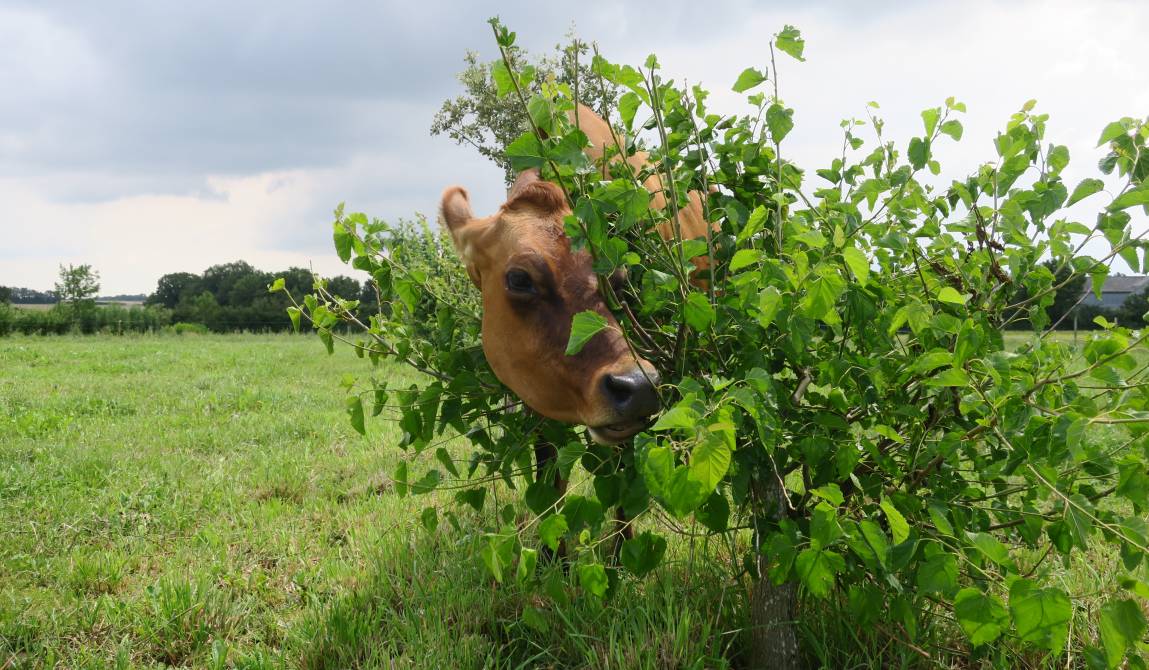
Photo credit: INRAE Ferlus
This second article in our silvopasture series explores how trees can support resilient livestock systems and regenerative agriculture in Canada, based on insights shared during the event held on April 9, 2026, organized by Groupe ProConseil in partnership with Regeneration Canada.
Missed the first article in the series?
Discover how producers are using trees to build resilient farms.
For years, trees in pasture systems were often seen mainly as sources of shade, shelter, wind protection, or simply something to work around. Now, farmers and researchers are also exploring how trees can help feed livestock.
It’s an idea that may seem surprising at first, but one that is gaining traction as producers face increasingly variable weather conditions, more frequent droughts, and rising input costs.
This growing interest comes at a time when many producers are looking for new ways to build resilience as they face more frequent droughts, rising input costs, and increasingly unpredictable weather.
The second edition of the Silvopasture information session, held on April 9, 2026, by Groupe ProConseil in partnership with Regeneration Canada, highlighted recent advances in this field. Researchers and advisors shared findings from multi-year projects conducted in partnership with producers across different regions and farming contexts in Quebec.
This article offers an overview of current knowledge and on-farm experimentation around silvopasture in Quebec—an approach that seeks to reintegrate trees into grazing systems to help protect livestock, improve soil health, and strengthen farm resilience.
While interest in silvopasture is growing, many practical questions remain around species selection, management, and how these systems can best fit Quebec farming realities.
What is Sylvopasture?
Silvopasture is the intentional integration of trees and shrubs and livestock in a mutually beneficial way.
| Derived from the Latin silva (“forest”), the prefix “silvo-” refers to wooded environments, while “-pasture,” derived from pastor, refers to grazing. Silvopasture can therefore be understood simply as the integration of trees and animals on the same land base. |
In these systems, trees used for shade or forage can be integrated:
- Around fields as hedgerows;
- Within pastures as hedgerows, tree rows, clusters, or scattered trees.
For producers, this can help:
- Diversify forage sources
- Protect animals from heat stress
- Make use of less productive land, such as sloped, wet, or difficult-to-mechanize fields
- Protect soils from erosion while improving water quality and biodiversity
- Regulate water temperatures when trees are planted along waterways (riparian buffers)
Systems Already Being Tested on Farms
Several projects presented during the event, including work shared by Julien Fortier from Éco-Corridors Laurentiens, showed that silvopasture systems have already been used for more than 20 years in certain parts of Quebec.
-

Photo: Fifteen-year evolution of a multi-species riparian buffer contributing to biodiversity, microclimate regulation, and biomass production at Ferme Lamontagne (Magog, Quebec). Credit: Fiducie de recherche sur la forêt des Cantons-de-l’Est. For example, riparian buffer strips planted with poplars in Estrie have contributed to:
- high biomass (wood) production
- increased biodiversity
- the creation of shade and beneficial microclimates for livestock
Research observations also suggest that more fertile sites may support greater biomass production and higher nutritional value in woody forage systems.
To help avoid competition between animal feed and human food production, the agroecology platform at Agriculture and Agri-Food Canada in Sherbrooke established new agroforestry plots on sloped land that is difficult to mechanize. These sites will serve as living laboratories to test different tree species and pruning methods adapted to grazing dairy cattle. Woody Forage: A Promising Resource
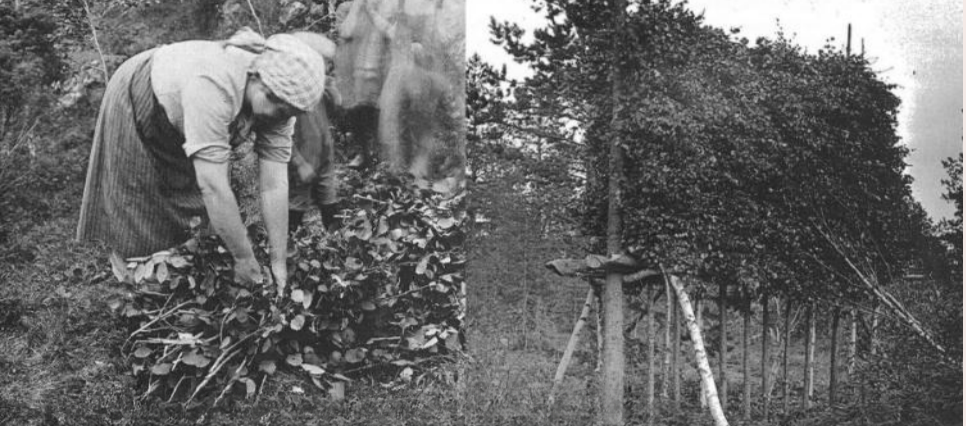
Photo: Practices once common—such as feeding livestock with tree forage—are now inspiring new approaches to animal production systems. Source: Slotte, 2000, shared by Shana Hansen. As explained by Joël Passicousset (Biopterre), the use of trees as animal feed was once common practice in many parts of the world before gradually disappearing with the mechanization and industrialization of agriculture.
Today, this practice is returning for a simple reason: trees continue producing biomass even when pasture productivity declines.
Thanks to their deep root systems, trees can access water and nutrients deeper in the soil profile. As a result, they tend to tolerate drought conditions better. Preliminary results in Quebec showed that in 2025, the forage quality of woody species remained stable throughout the growing season.
For producers, this could represent an important complementary forage source during the summer months. In the context of a changing climate, this makes woody forage a promising avenue for stabilizing forage production.
Surprising Nutritional Value
Contrary to the common perception that “leaves aren’t nutritious,” several analyses presented during the event showed that woody forages can offer surprisingly competitive nutritional profiles.
Preliminary findings presented by Cécile Tartera (UPA – Living Lab – Racines d’avenir) on spontaneous browsing behaviour in Quebec cattle and sheep farms showed that:
- woody forages have an energy values comparable to herbaceous forages
- protein levels can rival a first-cut hay harvest
- digestibility remains relatively strong throughout the summer
Perhaps most interestingly, while pasture quality often declines later in the season, woody species appear to maintain more stable nutritional value over time. This could make them a valuable forage complement during late summer grazing periods.
Which Tree Species Show the Most Promise?
Several species are currently under study, but some are already standing out in Quebec-based silvopasture projects.
As presented by Julien Fortier (Éco-Corridors Laurentiens), hybrid poplars appear particularly promising for Quebec silvopasture systems because of their:
- rapid growth
- strong regrowth capacity after cutting
- high biomass potential
- good palatability observed in cattle
- ability to quickly create shade
The forage production potential and feed value of several hybrid poplar clones had already been documented in Quebec as early as the late 1970s (Vallée and Chamberland, 1978).
Other species showing interesting potential include:
- hybrid willows
- black ash
- red-osier dogwood
- mountain maple
Species selection remains highly context-dependent and should be adapted to local climate, soils, and production systems.
Not all species are consumed equally by livestock; some are clearly more palatable than others.

Figure: Preliminary ranking of the palatability of different woody species, from least palatable (left) to most palatable (right), observed during a project conducted at Ferme Écoboeuf. Balsam poplars, trembling aspens, and pussy willows appeared to be particularly appreciated by livestock. Figure adapted from: Joël Passicousset, Biopterre. For more information on species selection, see the “Further Resources” section below.
Well-Known Benefits Still Being Studied in Quebec
Of course, integrating trees into pastures is not only about producing forage.
Silvopasture systems may also contribute to:
- reduced heat stress for livestock
- increased stable soil carbon
- greater biodiversity
- improved soil health

Photo: Cattle consuming woody forage at Ferme Écoboeuf (Abitibi, Quebec). Credit: Ferme Écoboeuf. Research conducted by Vincent Poirier (UQAT) at Ferme Écoboeuf suggests that systems combining trees with adaptive multi-paddock grazing management are already showing increases in stable soil carbon and plant species diversity after only a relatively short period of time.
These findings suggest that integrating trees may help strengthen pasture resilience alongside rotational grazing practices.
A Practice Still in Development
Despite its potential, silvopasture is still in its early stages in the Quebec, and many questions remain:
- Which species are best adapted to different regions?
- What yields can realistically be achieved?
- Which management and harvesting methods should be developed?
- Which species are safe for livestock consumption?
Concerns around the potential toxicity of certain tree species, including oaks and maples, were also discussed. While few incidents are reported in practice, scientific understanding remains incomplete.
Similarly, tannins—often perceived negatively—may actually have beneficial effects at low concentrations. Their exact role and relationship to palatability remain areas for further research.
These open questions are precisely why this event continues to matter: they create space to advance collective learning and share emerging knowledge around silvopasture systems.
What if the Pastures of Tomorrow Looked a Little More Like Those of Yesterday?
As farmers adapt to growing climate challenges, some agricultural practices are evolving by revisiting older approaches through the lens of modern research.
Silvopasture reflects this shift. More than a single practice, it represents a broader approach to working with living systems.
This is where the connection with regenerative agriculture becomes especially clear: producing food while supporting ecosystem health, building healthier soils, and restoring resilience, biodiversity, and complexity to the landscape.
Further Resources
Interested in learning more about woody forage and silvopasture?
- Report: L’agroforesterie : quels bénéfices pour les productions laitière et de bovin de boucherie au Québec? Cécile Tartera, Groupe ProConseil, 2025 – in french
- Book: Arbres fourragers : de l’élevage paysan au respect de l’environnement
Jérôme Goust, 2017 (French context) – in french - Julien Fortier’s work (Éco-Corridors Laurentiens) on Agri-Réseau – in french
- Resources shared by Shana Hanson, Three Streams Farm, Belfast, Maine
- Follow the silvopasture project at Ferme Écoboeuf on Facebook
- Explore the first results from the OasYs experimental silvopasture system in France – in french
- Discover agroforestry resources in our Toolbox for Regeneration
📩 Want to discover more examples of regenerative principles in action on Canadian farms and stay updated on upcoming events?
Subscribe to our newsletter to follow how producer-led regenerative practices are helping restore ecosystems and strengthen our food system.
Connect with us on social media and share how silvopasture or agroforestry is being explored in your region or farming context.